


You often see NPS (Nominal Pipe Size) and DN (Diameter Nominal) when working with pipes. NPS uses inches, and DN uses millimeters to describe pipe size. If you want to make sure your pipes fit and work safely, you need to understand both.
- NPS gives you a standard way to name pipe sizes.
- DN shows you the metric size for the same pipes.
- Using both helps you avoid mistakes and keeps your system reliable.
You can use the NPS to DN Conversion chart below for fast and accurate results in real projects.


What Are NPS and DN?
NPS Meaning
NPS stands for Nominal Pipe Size. People use NPS in North America and some other places. NPS names pipe sizes in inches. ASME makes the rules for NPS. NPS does not match the real pipe diameter. It gives a “nominal” size to help you pick pipes fast. For example, NPS 2 means a pipe with a nominal size of 2 inches. The real outside diameter is a little bigger.
Here is a quick comparison of NPS and DN:
| 측면 | NPS (Nominal Pipe Size) | DN (Diameter Nominal) |
|---|---|---|
| 단위 | Inches | Millimeters (mm) |
| Nominal Diameter Representation | Nominal pipe size (not directly corresponding to actual size) | Nominal diameter (close to actual outside diameter) |
| Primary Usage Region | North America and related regions | International standards (ISO) and most other regions |
| Representation | NPS 1/2, NPS 2, NPS 4, etc. | DN 15, DN 50, DN 100, etc. |
| Actual Size Meaning | Typically refers to nominal inside or outside diameter, actual size depends on wall thickness (Schedule) | Typically refers to nominal outside diameter |
| Common Range | NPS 1/8 to NPS 36+ | DN 6 to DN 900+ |
| Standard Reference | ASME B36.10M, ASME B36.19M | ISO 6708 |
DN Meaning

DN stands for Diameter Nominal. Most countries outside North America use DN. DN uses millimeters for pipe size. ISO sets the DN rules. DN numbers do not show the exact pipe size. They give a rounded number close to the outside diameter. For example, DN 50 means a pipe with a nominal diameter of 50 millimeters. The real outside diameter can be different.
- DN is the metric version of NPS.
- DN is dimensionless and should not be used for calculations unless a standard says so.
- The number after DN does not show the exact size.
Why Both Are Used
You need NPS and DN because different places use different standards. North America uses NPS. Most other countries use DN. Some projects need pipes from both systems. Rules and international jobs make it important to know both. When you convert NPS to DN, you make sure pipes fit and meet safety rules. You avoid mistakes and delays by knowing both systems.
Tip: Always check the outside diameter (OD) when picking pipes. NPS and DN are only nominal values. Use charts to compare sizes and make sure pipes fit right.
NPS to DN Conversion Methods
Standard Formula
You can convert pipe sizes using a simple formula. For most pipes above NPS 3.5, you multiply the NPS size by 25 to get the DN value. This method helps you switch between inch-based and metric systems quickly. You will find this formula useful for larger pipes, especially in international projects.
- Multiply the NPS size by 25 for pipes above NPS 3.5.
- Use this method for fast NPS to DN Conversion in most cases.
- Check the chart for exact matches if you work with smaller sizes.
For example, if you have an NPS 6 pipe, you multiply 6 by 25. The result is DN 150. This makes it easy to compare and select pipes for your system.
Exceptions and Notes
You need to pay attention to some exceptions when you use the NPS to DN Conversion formula. For pipe sizes from NPS 1/8 to NPS 12, the conversion does not always follow the formula exactly. The actual outside diameter (OD) can differ from the nominal size. This difference can cause confusion and mistakes.
Here is a table that shows how NPS and OD relate and why you should check both:
| Measurement Type | Basis of Measurement | Impact on Conversion Accuracy |
|---|---|---|
| NPS | Approximate inside diameter (ID) | Can lead to confusion when converting to DN sizes. |
| OD | Actual outer diameter | Essential for accurate specifications and fittings. |
You should always check the OD before you order or install pipes. The NPS size gives you a nominal value, but the OD tells you the real size. This step helps you avoid mismatches and installation problems.
Common Pitfalls
You may run into problems if you do not follow the right steps for NPS to DN Conversion. Here are some common pitfalls and ways to avoid them:
- Make sure all components match nominal diameters. If you mix sizes, fittings may not work.
- Remember that nominal diameters do not always show the real size. This can affect your cost calculations.
- Watch out for unit confusion. DN uses millimeters, and NPS uses inches. Mixing them up can cause ordering errors.
- Check that all parts meet design specifications. This keeps your system efficient and prevents failures.
Tip: Always use a conversion chart and double-check measurements. This habit saves you time and money.
You can avoid most mistakes by following these steps and understanding the differences between NPS and DN. Use the standard formula for larger pipes, but check the chart and OD for smaller sizes. This approach helps you make accurate choices and keeps your piping system safe.
NPS to DN Conversion Chart
Chart Overview
You need a simple way to compare pipe sizes. The NPS to DN Conversion chart gives you a quick reference for the most common sizes in industrial 관. You see both inch-based NPS and metric DN values side by side. The chart also shows the actual outside diameter (OD) in millimeters and inches. This helps you match pipes and fittings with confidence.
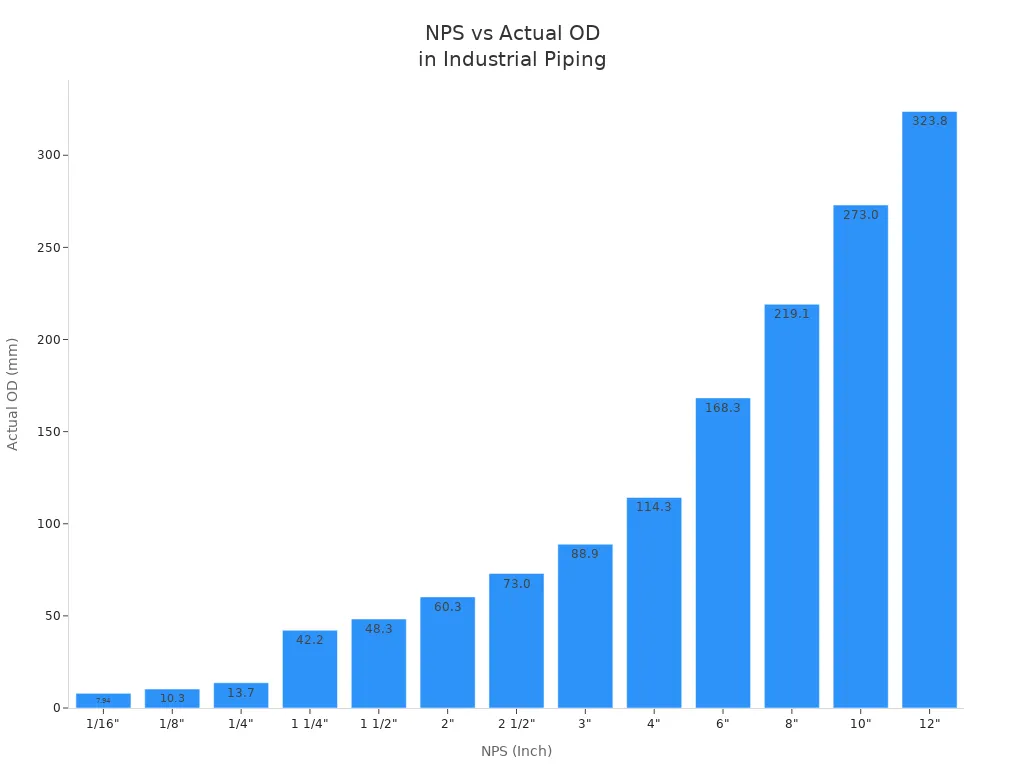
Common Sizes Table
Here is a table with the most frequently used pipe sizes. You can use this table to find the right match for your project.
| NPS (Inch) | DN (Metric) | Actual OD (mm) | Actual OD (in) |
|---|---|---|---|
| 1/16″ | DN 3S2 | 7.94 | 0.3125 |
| 12″ | DN 300 | 323.8 | 12.750 |
Tip: Always check both the DN and the actual OD before you order or install pipes. This step helps you avoid mismatches.
How to Read the Chart

You can use the chart for fast and accurate pipe selection. Follow these steps:
- Find the NPS size you need for your project.
- Look across the row to see the matching DN value.
- Check the actual OD in millimeters and inches.
- Make sure your fittings and other parts match the OD for a safe fit.
You use this chart to keep your specifications consistent. You avoid mistakes when working with global 표준. You also make sure your system works well by picking the right size every time.
- You improve your calculations for flow and pressure.
- You manage your inventory better.
- You install and maintain pipes with fewer problems.
- You work with different standards without confusion.
Note: The chart helps you with NPS to DN Conversion in real-world projects. You save time and reduce errors by using it as your quick reference.
Using the Chart
Conversion Steps
You can use the chart to convert pipe sizes quickly. Follow these steps to get the right match for your project:
- Find the NPS size in the first column of the chart.
- Look across the row to see the DN value and the actual outside diameter.
- Check the OD in millimeters and inches to make sure it fits your needs.
- Write down the DN value for your records or ordering process.
Tip: Double-check the OD before you buy or install pipes. This step helps you avoid costly mistakes.
Pipe Selection Tips
You want to pick the right pipe every time. Here are some tips to help you:
- Always compare both NPS and DN values. This keeps your system safe and reliable.
- Use the actual OD to match fittings and valves. The OD gives you the real size.
- Check the material and schedule of the pipe. These details affect strength and flow.
- Ask your supplier for help if you see a size that does not match your chart.
| Step | What to Do | Why It Matters |
|---|---|---|
| 1 | Check NPS and DN | Ensures correct sizing |
| 2 | Confirm OD | Prevents mismatches |
| 3 | Review schedule | Matches pressure needs |
Practical Examples
You might work on a project that needs both NPS and DN sizes. Here are some real-world scenarios:
- An engineer needs to connect a 2-inch NPS pipe to a European system. The chart shows DN 50 as the match.
- A contractor orders pipes for a building. The chart helps them pick DN 100 for a 4-inch NPS pipe.
- A DIYer replaces a home water line. They use the chart to find DN 20 for a 3/4-inch NPS pipe.
You can use the NPS to DN Conversion chart for these tasks. The chart saves you time and helps you avoid errors.
Note: Always keep the chart handy when you work with pipes from different standards.
Troubleshooting and FAQs
Standards Differences
NPS and DN do not always match up. NPS comes from America and uses inches. DN comes from the metric system and uses millimeters. This can make things confusing when you switch sizes. You might think a pipe marked NPS 2 is exactly 2 inches wide. But the real size can be different. DN numbers also do not always show the real outside diameter.
Always check the nominal size and the actual outside diameter before you buy or install pipes.
Here are some problems you might see:
- NPS uses inches, but DN uses millimeters.
- The real pipe size may not match the nominal size.
- You might mix up the two systems if you do not check carefully.
Measuring Tips
You need to measure pipes the right way to avoid mistakes. Use a tape measure or caliper to check the outside diameter of the pipe. Write down the size in both inches and millimeters. Compare your numbers with the conversion chart. This helps you pick the right fittings and stops mismatches.
Here is a table showing common conversion mistakes and how to stop them:
| Common Error | Prevention Method |
|---|---|
| Data loss or corruption | Save your data and use good conversion methods. Always check your results. |
| Inconsistent or duplicated data | Make clear rules for conversion. Clean your data and remove repeats. |
| Degraded data quality | Check your measurements. Use good tools and look over your work. |
| Compromised data security | Keep your data safe with passwords and follow safety rules. |
Tip: Measure twice and write down your results. This habit helps you avoid expensive mistakes.
Unlisted Sizes
Sometimes your pipe size is not in the chart. This can happen with custom or old pipes. If this happens, measure the outside diameter carefully. Write down the size and compare it to the closest standard size. You can ask your supplier for help or look in manufacturer catalogs.
- Measure the outside diameter with a caliper or tape.
- Compare your size to the chart.
- Ask your supplier if you need a special size.
Note: If you are not sure, always check with a professional or your supplier. This keeps your project safe and running smoothly.
You make your system safer and better when you change NPS to DN the right way. Getting the size right helps pipes last longer. It also helps meet safety rules. If you make mistakes, it can cost more money. Mistakes can also slow down your work. Use the chart to check sizes fast and avoid problems.
- Save the chart for later projects.
- Always look at wall thickness and size.
- Use the chart when you work with other countries.
Doing these things keeps your system working well and helps you finish your job.
자주 묻는 질문
What does “nominal” mean in pipe sizing?
“Nominal” is just a name for the pipe size. It does not show the real measurement. You use it to make talking about pipes easier. Always check the outside diameter to make sure the pipe fits.
Can you use NPS and DN sizes interchangeably?
You cannot swap NPS and DN sizes. NPS uses inches, but DN uses millimeters. Always look at both the name and the real outside diameter before you pick or buy pipes.
Why does the actual pipe diameter differ from the nominal size?
The nominal size is a label for the pipe. The real diameter changes because of wall thickness and how the pipe is made. You should measure the outside diameter to get the right size.
How do you measure a pipe for conversion?
Use a tape measure or caliper to check the outside diameter. Write down the size in millimeters and inches. Look at the conversion chart to find the right NPS or DN size.

