


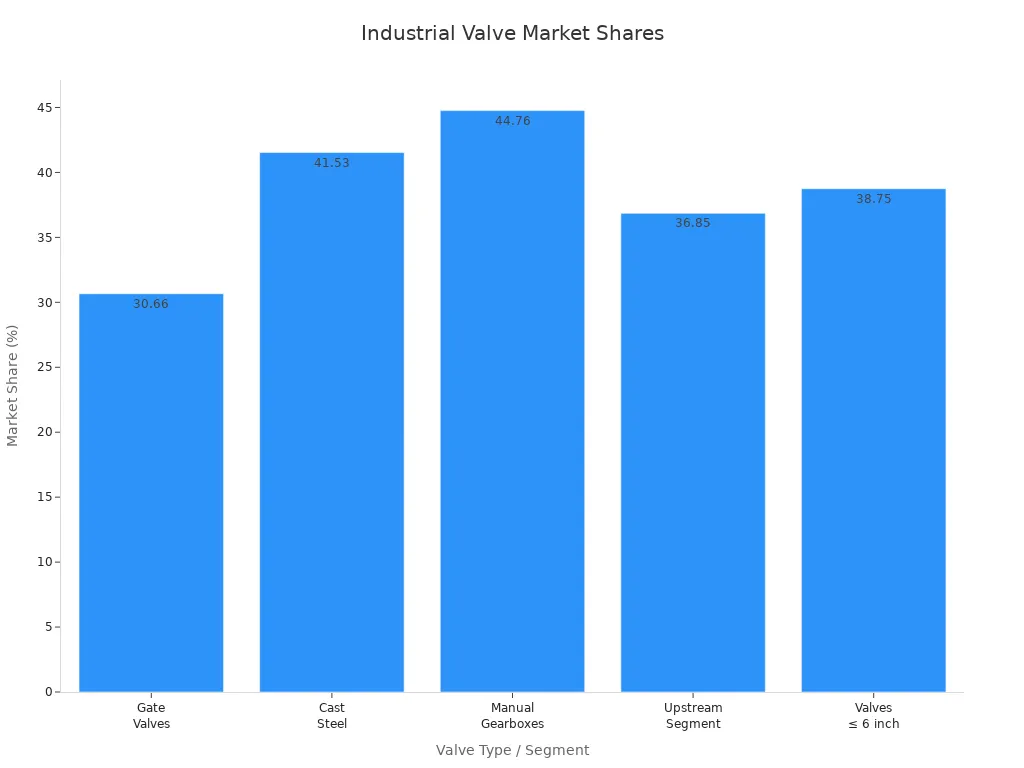
You see many kinds of industrial valves in oil and gas work. These include gate, globe, ball, butterfly, check, plug, pressure relief, control, and bellow sealed valves. Each valve type has a special job. They help control flow, pressure, and safety. The table below shows the market share for some common valve types:
| Valve Type | Market Share (%) |
|---|---|
| Gate Valves | 30.66 |
| Cast Steel | 41.53 |
| Manual Gearboxes | 44.76 |
| Upstream Segment | 36.85 |
| Valves ≤ 6 inch | 38.75 |
Valves help stop too much pressure. They help avoid equipment breaking. They also help follow safety rules. Smart valve technology and automation make things work better and safer. This is very helpful in dangerous places.
Key Takeaways
- Industrial valves help control flow and pressure in oil and gas work. They keep things safe and make sure everything runs well.
- Taking care of valves often stops leaks and keeps equipment working. This saves money and helps protect the environment.
- Picking the right valve for your job makes the system work better. It also helps follow safety rules.
- Knowing what valves are made of and if they work with certain fluids is important. This stops rust and helps valves last longer.
- Learning about new industry rules keeps things safe. It also helps avoid big fines or shutting down operations.
Industrial Valves Overview
Role in Oil and Gas Operations
Industrial valves are important in oil and gas operations. They help control how liquids and gases move. Valves manage flow and pressure from start to finish. Flow control valves change the speed and direction of materials. Gate valves can shut off parts of a pipeline for repairs. Pressure safety valves open if pressure gets too high. This stops equipment from breaking. Emergency shutdown valves close fast if something goes wrong. They keep people and equipment safe. Globe valves help control strong flows of crude oil. This keeps other steps in the process steady.

Industrial valves are like the brain of your system. How well they work affects safety and how much money you make.
New valve designs help you get better results. Stronger materials and new shapes save energy. This means you use less power and help the planet. Automation lets you control valves more exactly. It also makes things faster and safer. You can pick special customized valves for your needs. This helps your system work better and safer.
| Year | Market Size (USD Billion) | CAGR (%) |
|---|---|---|
| 2024 | 58.4 | N/A |
| 2025 | 61.98 | 6.1 |
| 2035 | 112.39 | N/A |
The market for industrial valves is getting bigger. Companies spend more on new technology and better rules. For detailed market trends, refer to Allied Market Research.
Importance for Safety and Compliance
Safety and following rules are very important in oil and gas. Industrial valves help you meet tough laws and protect nature. If a valve leaks, you lose product and waste energy. Leaks can also hurt the environment. For example, a leaking valve at a refinery can waste fuel. This can also cause you to fail safety checks. At an ethanol plant, leaks can cost millions each year. Valve problems in pipelines can pollute water and harm animals.
Not following the rules can cost you a lot. You might pay fines of $10,000 each day. You must follow standards like API 6D. This helps you avoid shutdowns and legal trouble. Good valves stop accidents and keep your plant safe.
- Not following rules can lead to:
- Daily fines
- Plant shutdowns
- Legal problems
Tip: Check and fix valves often. This stops leaks, keeps nature safe, and helps you follow the rules.
Types of Industrial Valves
Gate Valves
Gate valves are important in oil and gas pipelines. You use them to start or stop the flow. They are best for blocking flow. Gate valves open all the way or close tightly. This helps stop leaks and keeps things safe.

- Main Functions and Benefits:
- They turn flow on or off.
- Fluids move straight through, so pressure stays low.
- They work with high pressure and heat.
- Good for thick or muddy fluids.
- They last long in tough places.
- They follow strict safety rules.
- Common Applications:
- Used in drilling
- Used in pipelines
- Used in refineries
- Used in petrochemical plants
Gate valves seal tightly and let fluids move smoothly. They help you follow safety and environmental rules.
| Advantage | Description |
|---|---|
| Minimal Pressure Drop | The design saves energy during flow. |
| Large Pipe Suitability | Works well in big pipes. |
| Simple Maintenance | Fewer parts make fixing easy. |
| Not for Throttling | Can break if used to slow flow. |
| Space Needs | Some types need more room above the valve. |
Globe Valves
Globe valves help you control flow very well. You can change how much fluid goes through. They are used a lot in oil and gas work. Globe valves are good for slowing down or stopping flow.
- Key Features:
- They let you control flow exactly.
- They work in many places.
- Used in steam lines and reactor feeds.
- Help chemical plants work better.
- Performance Notes:
- Globe valves can leak if the seal wears out.
- Dirt inside can make them stick or move hard.
- Checking often stops leaks and keeps them working.
Tip: Use globe valves for steady and careful control in your lines.
Ball Valves
Ball valves shut off flow fast and easily. You turn the handle a little to open or close it. This makes them great for emergencies and quick jobs.
- Benefits:
- Easy and quick to use.
- Seals tight to stop leaks.
- Works in high pressure and heat.
- Does not rust if made from stainless steel.
- Needs little fixing.
- Can be controlled from far away.
- Where You Use Them:
- Used in all parts of oil and gas work.
- Used in high-pressure pipes.
- Used where you need to stop flow quickly.
Ball valves keep your system safe and working well, even in hard places.
Butterfly Valves
Butterfly valves are small and light. You use them to control flow in big pipes. They open and close fast, which saves time.
- Advantages:
- Saves space.
- Works quickly.
- Good for big pipes and costs less.
- Easy to control with machines.
- Limitations:
- Not good for high pressure or vacuum.
- Can leak or wear out faster in tough spots.
- The disc stays in the flow and can make the fluid swirl.
- Typical Uses:
- Used in pipelines and refineries.
- Used for water, air, chemicals, and steam.
Note: Pick butterfly valves for big, low-pressure systems that need quick action.
Check Valves
Check valves let fluids go one way only. They stop flow from going backward. This keeps your system safe and stops damage.
- How They Work:
- Open when fluid moves forward.
- Close by themselves if flow goes back.
- Types You Might Use:
- Swing check: A disc swings open and shut.
- Lift check: A disc lifts up when fluid pushes.
- Axial flow: A spring moves a disc along the pipe.
- Ball check: A ball moves to let flow or block it.
- Diaphragm check: A soft part opens or seals as needed.
- Applications:
- Used at wellheads
- Used in pipelines
- Used in compressor lines
Check valves help you avoid damage and keep your process safe.
Plug Valves
Plug valves use a plug to control flow. You turn the plug to open or close it. They work well with thick or dirty fluids.
| Feature | Plug Valves | Ball Valves |
|---|---|---|
| Operating Torque | Needs more force to turn | Needs less force to turn |
| Flow Control | Good for slowing flow | Best for full open or closed |
| Maintenance | Needs less fixing than gate valves | Needs very little fixing |
| Applications | Used for gas and chemicals | Used for fast, automatic jobs |
- Benefits:
- Turns on or off quickly.
- Works well with rough or muddy fluids.
- Good for tough jobs that need strong shut-off.
- Limitations:
- Needs more force to use.
- Not as easy to control by machine as ball valves.
Use plug valves for simple, strong shut-off in dirty or thick fluid systems.
Pressure Relief Valves
Pressure relief valves keep your system safe from too much pressure. They open by themselves if pressure gets too high. This lets out extra fluid or gas.
- Key Roles:
- Stops explosions or breaks.
- Protects tanks and pipes.
- Lowers risk of costly stops and harm to nature.
- Where You Use Them:
- Used in storage tanks
- Used in high-pressure pipes
- Used in processing units
Pressure relief valves are your last defense against accidents from too much pressure.
Control Valves
Control valves help you manage flow, pressure, and heat. You use them to keep your system working well and safely.
- Selection Tips:
- Pick the right valve for your job.
- Make sure it can handle pressure changes and noise.
- Choose the right control valve for good flow control.
- Applications:
- Used for automatic control
- Used for steam and gas
- Used for liquid flow
Control valves help you adjust your process and make it work better.
Bellow Sealed Valves
Bellow sealed valves help you stop leaks and emissions. They use a metal part to seal the valve stem. This keeps fluids and gases inside.
- Benefits:
- EPA says they are zero-emission devices.
- Good for dangerous or very cold fluids.
- Made from strong metals for hard jobs.
- Welded all over to keep fluids inside.
- Applications:
- Used where no leaks are allowed.
- Used with dangerous or expensive fluids.
Bellow sealed valves help you protect nature and follow strict emission rules.
Industrial Valves Selection
Pressure and Temperature
When you pick industrial valves, check the pressure and temperature. Every valve has a top pressure it can handle. This tells you what is safe for your system. You also need to match the valve’s heat rating to your setup. High heat can make some materials weak. Always choose a valve that can handle heat and will not rust. The way the valve connects to pipes is important too. Good connections help stop leaks, especially when pressure is high. You should also check how much leaking is okay and make sure the valve fits your pipes.
- Maximum operating pressure
- Operating temperature and thermal cycling
- Valve material for reliability and corrosion resistance
- Connection end type for leak prevention
- Leakage tolerance for process safety
- Size availability for pipe compatibility
Tip: Always look at pressure and temperature ratings before putting in a valve. This keeps your system safe and working right.
Fluid and Flow Requirements
The kind of fluid and how it moves matters for your valve choice. Think about if the fluid is thick or thin, hot or cold, and if it has bits in it or can cause rust. Some fluids need special metal valves. Hot fluids may need valves that can take more heat. You also want a valve that matches how fast you want the fluid to move. Some valves open fast, others let you control flow slowly. Picking the right size helps stop pressure drops and keeps things running well.
- Fluid properties: viscosity, temperature, pressure, corrosiveness, and particle content
- Valve material and design for fluid compatibility
- Flow rate and pressure drop across the valve
- Valve sizing for optimal control
Note: Picking the right valve for your fluid and flow helps you control your system and avoid big problems.
Safety and Environmental Standards
You have to follow tough safety and environmental rules in oil and gas work. Valves must meet standards like ASME, API, and EN. ASME rules say how to design and test high-pressure valves. API rules help you pick and take care of safety valves. EN rules focus on strong design and caring for nature. These rules help stop leaks, keep the planet safe, and protect your plant.
- ASME: Design and inspection for high-pressure valves
- API: Sizing and maintenance for safety valves
- EN: Design integrity and environmental sustainability
Always pick valves that meet or beat industry rules. This keeps your team, your equipment, and nature safe.
Maintenance and Reliability
Maintenance Practices
You keep your system safe by doing good maintenance. Regular checks help you find problems early. Look for wear, rust, or leaks before they get worse. Test each valve to see if it works right. Make sure valves open and close when needed. Check seals and seats so nothing leaks inside. This keeps your process working well. Put oil on moving parts to stop them from wearing out. Clean around each valve to help it work better and stop dirt.

- Look at valves for damage or leaks.
- Test if valves open and close fast.
- Check seals and seats to stop leaks.
- Oil moving parts to stop rubbing.
- Clean around valves for better work.
Check check valves at least once every year. If the place is rough or has lots of rust, check more often. You might check every six months or every three months. Service pipeline ball valves once a year to stay safe. See our inspection services for more.
| Valve Type | Recommended Inspection Interval |
|---|---|
| Check Valves | At least once a year; more often in harsh conditions |
| Pipeline Ball Valves | Annually; regular schedule recommended |
Tip: Make a clear plan for checking each valve. This helps you stop surprise problems and keeps your plant safe.
Reliability Factors
You need good valves to control flow and pressure. The kind of valve and how you pick it matter a lot. How you take care of valves also matters. Buying new valves gives you good quality but can take time. Keeping extra valves ready stops delays but costs more money. Fixing and caring for valves saves money and keeps them working.
Rust outside or inside, bad seals, and worn parts can make valves fail. Pick valves made from strong stuff that fits your job.
- Good valves keep your system safe.
- Picking the right valve helps it work well.
- Taking care of valves makes them last longer.
- Rust and worn parts can cause problems.
- Strong materials stop valves from breaking.
Failure Prevention
You can stop valve problems by knowing what causes them. Rust is the main reason valves break. It can be even or in small spots. Fast-moving fluids or big drops in pressure can wear out parts. Heat changes can make metal weak over time. Using the wrong material makes valves break sooner. Parts can wear out if used a lot or if the fluid is rough.
| Cause of Failure | Description | Preventive Measures |
|---|---|---|
| Corrosion | Even or spotty rust | Use Titanium, Copper Nickel, Aluminum Bronze to stop rust |
| Erosion and Cavitation | Fast fluids or pressure drops | Pick Copper Nickel, Titanium for strong parts |
| Thermal Fatigue and Creep | Heat changes and tired metal | Use Titanium and special metals for high heat |
| Improper Material Selection | Wrong materials | Match materials to what you use and where you use it |
| Mechanical Wear | Parts wear out from rough flow or lots of use | Use hard materials and special fixes |
Pick the right materials and follow a good care plan. Industrial Valves last longer and work better if you stop these problems.
Note: Stopping problems early saves money and keeps your work going.
You use industrial valves such as gate, globe, ball, butterfly, check, plug, pressure relief, control, and bellow sealed valves to make oil and gas work safe and run well. Picking the right valve and taking care of it gives you lots of good things:
- You make your system work better and use less energy.
- Your equipment lasts longer and you do not have to pay for big repairs.
- You keep people safe and follow all the rules.
Learn about the latest industry rules. Ask experts for help so your system always works its best.
FAQ
What is the most common valve used in oil and gas?
You often use gate valves in oil and gas work. They help you start or stop flow in pipelines. Gate valves handle high pressure and last a long time.
How do you know when to replace a valve?
You should replace a valve if you see leaks, rust, or if it does not open and close right. Regular checks help you find these problems early.
Why do valves leak?
Valves leak when seals wear out, parts rust, or dirt builds up inside. You can stop leaks by checking and cleaning valves often.
How do you choose the right valve material?
You pick valve material based on fluid type, pressure, and temperature. For example, stainless steel works well with corrosive fluids. Always match the material to your process.
What standards should your valves meet?
Your valves should meet industry standards like API, ASME, and EN. These rules help you keep your plant safe and follow the law.

