


You need to follow important rules when picking a kelebek vana. These rules tell you the right size, materials, and pressure levels. Big groups like ASME, API, ISO, and EN make these rules.
| Standard Organization | Standart Ad | Tanım |
|---|---|---|
| ASME | ASME B16.34 | Valves — Flanged, Threaded and Welding End |
| API | API Standard 609 | Butterfly Valves: Double-flanged, Lug- and Wafer-type |
| ISO | ISO 10631 | Metallic butterfly valves for general purpose |
| TR | EN 593 | Metallic butterfly valves for general purposes |
You should check if your tedarikçi has ISO certification. This helps you trust the product and know it meets the rules.
Önemli Noktalar
- Know why standards like ASME, API, and ISO matter when picking butterfly valves. These standards help keep things safe and make sure parts work together.
- Pick the right butterfly valve type for your job. Different styles, like concentric and triple offset, are made for certain uses.
- Always look at the size and pressure rating before you put in the valve. If these match your system, you stop leaks and make sure it works right.
- Use the right materials for your butterfly valve based on the fluid and pressure. This choice affects how long the valve lasts and how well it works.
- Measure carefully with tools like calipers and measuring tapes. Good measurements help you avoid mistakes and make sure the valve fits well.
Butterfly Valve Overview
Types and Styles
There are many butterfly valve types used in factories. Each type is good for certain jobs. Here are some common styles you might see:
- Concentric butterfly valves help stop leaks. People use them in chemical plants and food factories.
- Double offset butterfly valves have a stem that is not in the center. This makes them last longer in hot places.
- Triple offset butterfly valves stop parts from rubbing together. These valves last longer and close tightly, even in hard jobs.
- Metal-seated butterfly valves work with strong chemicals and high pressure. They are good for steam and harsh fluids.
- Soft-seated butterfly valves use soft materials. They are best for low pressure and are simple to fix.
- High performance butterfly valves give better flow control. You find them in tough jobs.
- Waterworks double eccentric butterfly valves seal well and need less force to turn. Water pipes often use these valves.
Tip: Pick the right valve style for your system. This helps your valve work well and last longer.
Where Standards Apply
You should know which standards fit each butterfly valve type. Standards help make sure the valve fits and works safely. Different places and groups make these rules. Here are some common standards:
| Bölge | Design Standard | Test Standardı |
|---|---|---|
| British | BS-5155 (WAFER TYPE) | BS-6755(PT-1)(FLANGE&WAFER) |
| American | API-609 (OFFSET TYPE) | API-598 (butterfly, gate, globe, check) |
| MSS-SP67, MSS-SP68 | AWWA-C-504 | |
| ANSI-B-16.10 | ANSI-B-16.34 |
You will also see standards from groups like the Uluslararası Standardizasyon Örgütü (ISO), European Committee for Standardization, ANSI, BSI, CSA, DIN, EEMUA, and JSA. These groups help you pick valves that are safe and good quality.
Butterfly Valve Standards

MSS SP-67
You need to know about MSS SP-67 when you select a Butterfly Valve. This standard covers the main types, sizes, and pressure ratings for valves used in many industries. MSS SP-67 gives you clear rules for gofret, lug, concentric, offset, and flanged styles. It also tells you what materials you can use for each part of the valve.
Here is a table that shows the size ranges and pressure ratings for different Butterfly Valve types under MSS SP-67:
| Vana Tipi | Boyut Aralığı | Basınç Derecesi |
|---|---|---|
| Wafer Kelebek Vana | 2″ to 24″ | Up to 150 psi |
| Lug Kelebek Vana | 2″ to 24″ | Up to 150 psi |
| Eşmerkezli Kelebek Vana | 2″ to 12″ | Up to 150 psi |
| Single Offset Butterfly Valve | 4″ to 24″ | Up to 150 psi |
| Çift Ofset Kelebek Vana | 6″ to 48″ | Up to 300 psi |
| Üçlü Ofset Kelebek Vana | 6″ to 48″ | Up to 1500 psi |
| Flanşlı Kelebek Vana | 4″ to 72″ | Up to 1500 psi |
| Plastic Butterfly Valve | 1″ to 12″ | Up to 150 psi |
| Stainless Steel Butterfly Valve | 2″ to 36″ | Up to 300 psi |
MSS SP-67 also lists the materials you should use for each part. You can see the main parts and their materials in this table:
| Main Part | Malzeme |
|---|---|
| Vücut | Cast Iron, Ductile Iron |
| Koltuk | EPDM, NBR |
| Kök | SS 304, SS 316, SS 416, SS 431 |
| Disk | D.I. + Ni Plated, SS 304, SS 316, Bronze, Al-Bronze |
| Gear | Karbon Çelik |
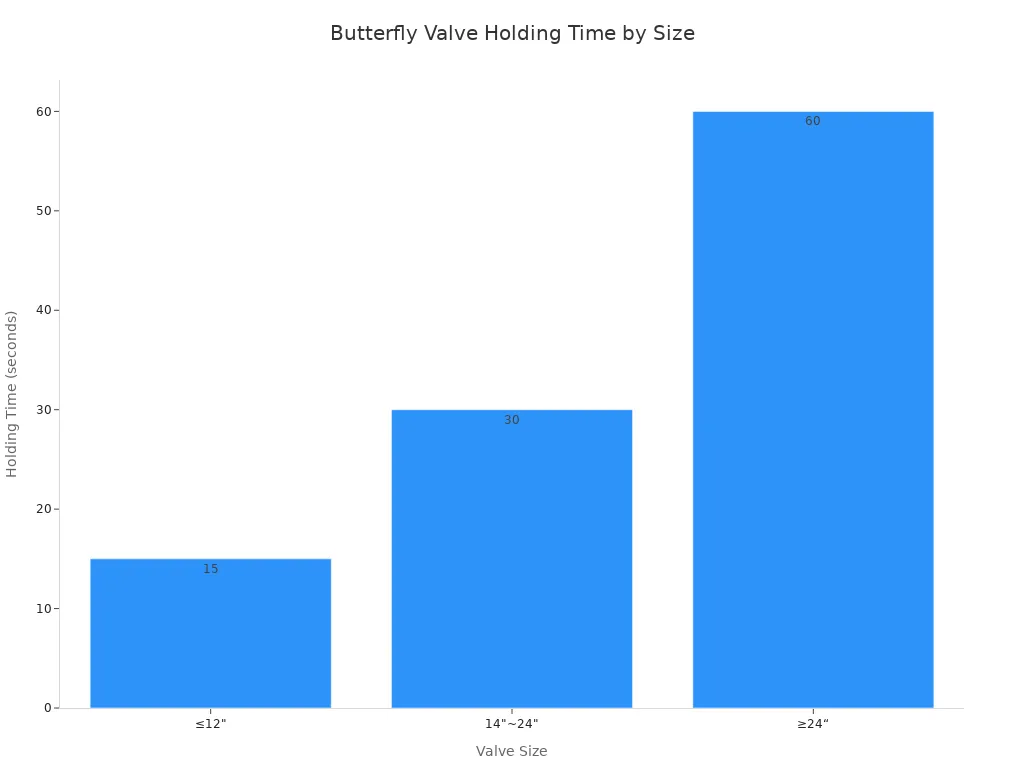
You must test each Butterfly Valve to make sure it works well. MSS SP-67 gives you holding times for pressure tests. The holding time depends on the size of the valve. Here is a chart that shows how long you need to hold the pressure for different sizes:
Note: Always check the size and pressure rating before you choose a Butterfly Valve. This helps you match the right valve to your system.
AWWA and ASME/ANSI
You will see AWWA and ASME/ANSI standards used for waterworks and industrial Butterfly Valve applications. These standards help you pick the right size and make sure the valve fits with pipes and flanges in your system.
AWWA standards, like AWWA C504, focus on large valves for water systems. ASME/ANSI standards, such as ASME B16.34, cover valves for many industries. Both give you clear size ranges. Here are the common sizes you will find:
| Boyut |
|---|
| 3 inç |
| 4 inç |
| 6 inç |
| 8 inç |
| 10 inç |
| 12 inç |
| 14 inç |
| 16″ |
| 18 inç |
| 20″ |
| 24 inç |
AWWA valves often start at 3 inches and go up to 24 inches or more. You will use these standards for both high and low pressure jobs. ASME/ANSI standards also tell you about pressure ratings and materials, so you can pick a valve that lasts.
Tip: Use AWWA for water pipes and ASME/ANSI for general industry. This keeps your system safe and working well.
DIN and International Standards
You may need to follow DIN or other international standards if you work outside the United States. DIN standards, like DIN 3202, set rules for face-to-face dimensions and tolerances. These rules help you make sure your Butterfly Valve fits with pipes from other countries.
Here is a table that compares the main standards and their tolerance rules:
| Standart | Tolerance Specification | Notlar |
|---|---|---|
| EN 558-2 | Specified tolerances by face-to-face dimensions | Similar to ANSI B16.10 and BS 2080 for certain sizes. |
| ANSI B16.10 | Tolerances based on valve size specifications | For ≤NPS 10 (DN 250mm) ±2mm, ≥NPS 12 (DN 300mm) ±3mm. |
| BS 2080 | Tolerances based on valve size specifications | Below 10in (DN 250mm) ±2.0mm, above 12in (DN 300mm) ±3.5mm. |
| DIN 3202 | Tolerances not segmented | Allowable deviation of ±0.5%, minimum 1mm. |
| GB/T 15188 | Tolerances according to caliber specification | Similar to ISO 5752 but with different dimensions. |
DIN and EN standards often match up with American standards for many sizes. You should always check the tolerance and face-to-face dimension rules before you order a Butterfly Valve for an international project.
Remember: Matching the right standard to your project helps you avoid leaks and fitting problems.
Key Dimensions of Butterfly Valves
Face-to-Face
You need to know the face-to-face dimension when you select a Butterfly Valve. This measurement tells you how much space the valve takes up between the pipe flanges. Wafer and lug styles have different face-to-face sizes, but both follow MSS SP-67 standards. The tables below show the standard face-to-face dimensions for common sizes.
| Boyut | A (mm) | B (mm) | L (mm) |
|---|---|---|---|
| 5″ | 127 | 213 | 55 |
| 6 inç | 139 | 226 | 55 |
| 8 inç | 175 | 260 | 60 |
| 10 inç | 203 | 292 | 67 |
| 12 inç | 242 | 337 | 76 |
| 14 inç | 267 | 368 | 76 |
| 16″ | 316 | 400 | 102 |
| 18 inç | 334 | 422 | 114 |
| 20″ | 370 | 480 | 127 |
| 22″ | 433 | 533 | 151 |
| 24 inç | 468 | 562 | 151 |
| 26″ | 484 | 540 | 172 |
| 28″ | 530 | 626 | 165 |
| 30″ | 565 | 660 | 167 |
| 32″ | 602 | 666 | 188 |
| 36 inç | 661 | 722 | 203 |
| 40″ | 724 | 806 | 216 |
| 48 inç | 869 | 938 | 276 |
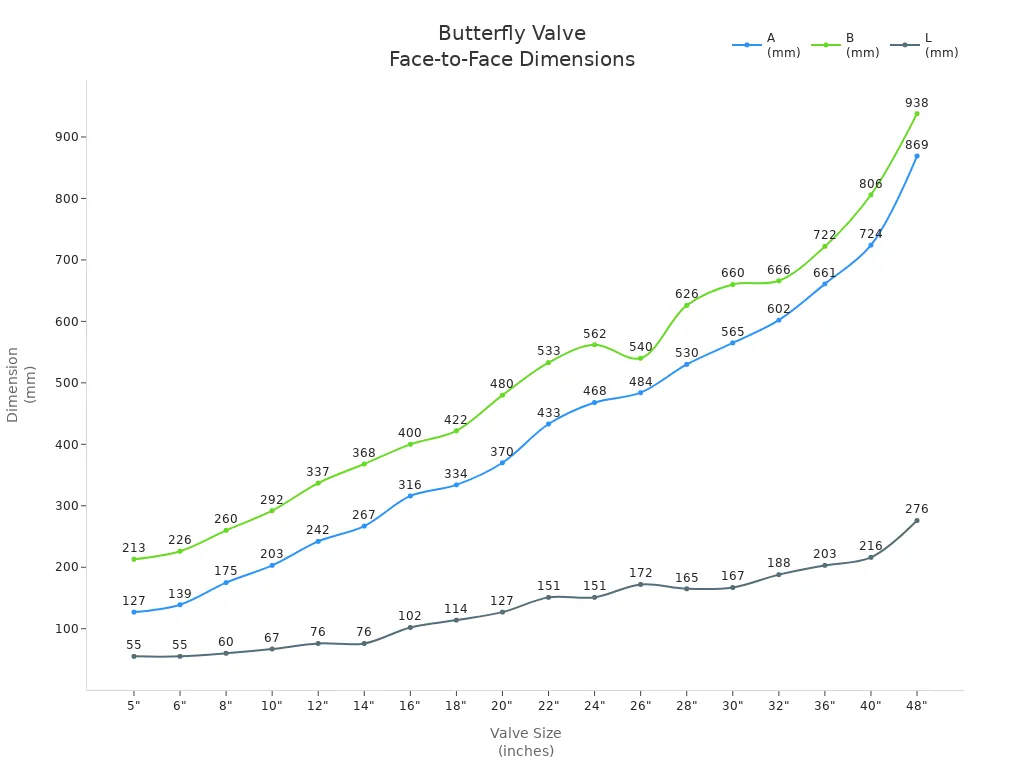
You should always check these measurements before you install a valve. This helps you avoid problems with fitting and alignment.
Valve Size Range
Butterfly Valves come in many sizes. You can find small valves for tight spaces and large valves for big pipes. Most standard valves range from 2 inches to 48 inches. Some waterworks valves go up to 72 inches. You need to match the valve size to your pipe size for a good fit.
- Small valves (2″–12″) work well for low-pressure jobs.
- Medium valves (14″–36″) handle higher flows and pressures.
- Large valves (40″–72″) control water in big pipelines and plants.
You should also check the pressure rating. Common ratings are 150 psi, 200 psi, and up to 1500 psi for special jobs. Always pick a valve that matches your system’s pressure needs.
Tip: Check both the size and pressure rating before you order a Butterfly Valve. This keeps your system safe.
Disc and Shaft
The disc and shaft are key parts of every Butterfly Valve. The disc controls the flow, and the shaft connects to the handle or actuator. You need strong materials for these parts. ASTM sets the standards for these materials.
| Malzeme Türü | ASTM Standard | Uygulamalar | Key Advantages |
|---|---|---|---|
| Martensitic Stainless Steel | ASTM A995 | Valve stems, shafts, wear parts | High hardness, wear resistance |
| Specialty Bronzes | ASTM B148 | Valve discs, gears, wear plates | High strength, excellent durability |
| Nickel Base Alloys | ASTM A494 | Corrosive environments | Great resistance to corrosion |
| Dubleks Paslanmaz Çelik | ASTM A995 | Seawater, chemical processing | Twice the strength of regular steel |
You should choose the right material for your job. For example, use duplex stainless steel for seawater. Use bronze for high wear. This helps your valve last longer and work better.
Flange and Bolting
You need to connect your Butterfly Valve to the pipeline using flanges and bolts. The flange drilling pattern follows ASME/ANSI standards. You must match the number of holes, hole size, and bolt circle diameter to your pipe flanges.

- The bolt pattern uses class numbers like Class 150 or Class 300.
- AWWA uses pressure class letters (A, B, D, E, F), which are different from ASME/ANSI classes.
- Lug-style valves have threaded lugs on the valve body for bolt connections.
- Wafer-style valves have holes that line up with the pipeline flanges and clamp between them.
- Wafer valves use long bolts that go through both flanges.
- Lug valves use short bolts that screw into the valve body from each side.
- Lug valves have their own flanges with tapped holes, so you do not need nuts.
You should check the flange and bolting details before you install the valve. This helps you avoid leaks and makes sure the valve fits your system.
Note: Always match the flange pattern and bolting method to your pipe system. This prevents installation problems.
Butterfly Valve Dimension Charts
Standard Size Tables
You can use standard size tables to help you choose the right Butterfly Valve for your project. These tables show the main dimensions for each valve size, such as face-to-face length, flange diameter, and bolt circle. MSS SP-67 and AWWA standards provide clear charts for wafer and lug styles. You will see sizes listed in inches or millimeters. For example, a 6-inch valve may have a face-to-face length of 55 mm and a flange diameter of 226 mm. These tables make it easy for you to match the valve to your pipe system.
Tip: Always check the size table before you order. This helps you avoid mistakes and makes sure your valve fits.
| Valve Size (in) | Face-to-Face (mm) | Flange Diameter (mm) | Bolt Circle (mm) |
|---|---|---|---|
| 6 | 55 | 226 | 152 |
| 8 | 60 | 260 | 165 |
| 10 | 67 | 292 | 178 |
| 12 | 76 | 337 | 190 |
Tolerances and Variations
You need to pay attention to tolerances and variations when you install a Butterfly Valve. Tolerances tell you how much the actual measurements can differ from the standard size. Wafer and lug styles have different tolerance rules. Lug style valves need very precise flange hole pitch and threaded hole angles. If the pitch circle diameter (PCD) is off by more than 0.5 mm, the valve may not fit. For example, a batch of DN150 lug style valves failed because the PCD measured 152.4 mm instead of the required 152±0.5 mm. The threaded holes also had a perpendicularity deviation of 0.8°, which was higher than the allowed 0.5°.
- Wafer style valves have more flexible tolerances.
- Lug style valves need tighter control for flange holes and threads.
- Always measure carefully before installation.
Note: Small errors in tolerance can cause leaks or make the valve impossible to install. You should always check the manufacturer’s tolerance chart.
Measuring Butterfly Valves
Tools and Methods
You need the right tools to measure butterfly valves accurately. Using the correct method helps you avoid errors and ensures your valve fits the system. Here are some tools and how you can use them:
- Caliper: Use this tool to measure the diameter of the disc at its widest point. You can also use it to check the diameter of bolt holes.
- Ölçme Bandı: This tool helps you measure the pitch circle diameter (PCD) of the bolt holes. You can also use it to find the nominal diameter of the pipeline.
- PCD Gauge: This tool gives you a quick and accurate way to check the pitch circle diameter for bolt holes.
- Ruler: Use a ruler to measure the face-to-face dimension, which is the distance between the two faces of the valve.
You should always double-check your measurements. Write down each value as you go. This practice helps you avoid confusion later.
Tip: Clean the valve and remove any debris before you start measuring. Dirt or rust can affect your results.
Sık Yapılan Hatalar
Many people make simple mistakes when measuring butterfly valves. You can avoid these problems if you know what to watch for:
- You might measure from the wrong points on the valve. Always check the manufacturer’s diagram before you start.
- Some people forget to measure the pitch circle diameter (PCD) correctly. If you skip this step, the valve may not fit the flange.
- Using worn or inaccurate tools can give you the wrong numbers. Always use tools in good condition.
- You may round off numbers too early. Write down the exact measurement first, then round if needed.
- Sometimes, people measure only one side of the valve. Always check both sides to make sure the valve is not warped.
Note: Careful measuring saves you time and money. Double-check your work to avoid costly installation errors.
Butterfly Valve Sizing and Selection
Başvuruyla İlgili Hususlar
You have to pick the right size valve for your system. First, check the pressure rating. The valve must handle the highest pressure in your pipes. Pick the best valve type for your job. Concentric, double-offset, and triple-offset valves work for different pressures. Choose materials that match the fluid in your pipes. Look at the main sizes before you buy:
- Nominal Diameter (DN): Inside diameter of the valve
- Face-to-face dimension: Distance between the valve faces
- Outside Diameter: Size of the valve body
- Bolt Circle Diameter: Circle through the bolt holes
- Number and size of bolt holes
- Disc Diameter and Shaft Diameter
- Thickness of the valve body
If the valve is too small, not enough fluid will flow. If the valve is too big, it may leak or not seal well. Picking the right size saves money and means less fixing later.
Tip: Always check the pressure drop across the valve. A high pressure drop costs more energy and may change what material you need.
Material and Pressure
You must pick materials that fit your fluid and pressure. Cast steel valves are good for water, oil, and steam. They are strong and can handle high pressure. If your pipes have acid or chloride, use valves with special coatings or stainless steel seats. Pressure ratings change with valve size and material. Carbon steel, stainless steel, and noble alloys work for higher pressures than bronze or cast iron.
| Malzeme Türü | En İyisi İçin | Basınç Derecesi |
|---|---|---|
| Dökme Çelik (WCB) | Water, oil, steam | Yüksek |
| Paslanmaz çelik | Corrosive fluids | Yüksek |
| Bronze, Cast Iron | Mild fluids | Düşük ila Orta |
Ensuring Compliance
You need to make sure your valve follows the rules. Do these steps:
- Check if the valve meets quality and safety rules.
- See if it follows API, ANSI, ASTM, and ISO.
- Pick valves certified by trusted groups.
Note: Using certified valves keeps your system safe and working right.
You should learn about butterfly valve dimensions, standards, and how to pick the right one. This helps your system stay safe and work well. Always look at the dimension charts before you buy a valve.
- Make sure the flange standards match your pipes.
- Learn how wafer and lug valves are different.
- Check the manufacturer’s datasheet for all details.
Using standards like API and ASME makes your system safer and more reliable. Pick the correct valve, put it in the right way, and do regular maintenance. This will help your project work better and last longer.
SSS
What is the most common size range for butterfly valves?
You will find most butterfly valves in sizes from 2 inches to 48 inches. Some special valves for waterworks can reach up to 72 inches.
How do you know which standard to use for your project?
You should check your project location and industry. Use AWWA for water systems in the US. Use DIN or EN for European projects. Always match the standard to your pipe and flange requirements.
Can you use the same butterfly valve for water and chemicals?
No, you cannot always use the same valve. You must check the valve material. For chemicals, choose valves with special coatings or stainless steel parts. For water, cast iron or ductile iron works well.
What tools help you measure a butterfly valve?
You can use a caliper, measuring tape, or PCD gauge. These tools help you check the face-to-face dimension, disc diameter, and bolt circle. Always clean the valve before measuring.

