


In plant operations, thermal expansion isn’t just a physics problem—it’s a multi-million dollar reliability issue. When piping systems heat up and cool down, the resulting forces can buckle pipes, compromise flange seals, and seize valves. Ignoring it leads to unsafe conditions, diffuse emissies, and costly downtime. Understanding how to manage these forces is critical for any engineer.
The Real Risks of Thermal Expansion on Valves
How Unchecked Expansion Destroys Valve Integrity
When pipes heat up, they get longer. A lot longer. When they’re constrained (and they always are), that growth translates into immense compressive stress. This force doesn’t just stay in the pipe; it transfers directly to the weakest points—often the valve bodies and flanges. This is what engineers refer to as excessive “nozzle loads.”
This stress can warp the valve body, causing seals to misalign and leak. In other cases, it can cause the valve to bind or “stick,” making it difficult or impossible to operate. The opposite is also true in cryogene applications, where thermal contraction can pull joints apart and cause leaks.
These risks are serious. A 2001 incident investigation found a fire in a 6-inch kogelkraan on an oxygen line was initiated by contaminants. The stress from thermal cycles was a likely contributor to the initial breach that allowed the fire to start.
When pressure and stress combine, the failure modes multiply. Sudden pressure changes can also lead to waterhamer, which sends a shockwave through the system, damaging internal components.
| Fault Cause | Fault Manifestation (What You See in the Field) |
|---|---|
| Spring deformation (from stress) | Valve is hard to adjust, flow is erratic, temperature fluctuates. |
| Liquid impact / Water hammer | Poor control, pressure swings on the low-pressure side. |
| Spring fatigue / Seal aging | Leaks (fugitive emissions), poor cooling/heating efficiency. |
The Cause: A Game of Physics and Materials

Why Pipes Move So Much
All materials expand with heat. The amount of movement is a simple formula: ΔL = L × α × ΔT.
- ΔL = The change in length
- L = The original length of the pipe
- α = The coefficient of thermal expansion (this is the key material property)
- ΔT = The change in temperature
The problem is that different materials expand at vastly different rates. As you can see in the table, plastic pipes (PVC, CPVC) move significantly more than metal pipes. This is why you see plastic water pipes “snake” in trenches—it’s a simple way to allow for this growth.
| Materiaal | 25 °F ΔT | 50 °F ΔT | 75 °F ΔT | 100 °F ΔT | 150 °F ΔT |
|---|---|---|---|---|---|
| Fiberglass | 0.31″ | 0.61″ | 0.92″ | 1.23″ | 1.84″ |
| PVC | 0.90″ | 1.80″ | 2.70″ | 3.60″ | 5.40″ |
| CPVC | 1.14″ | 2.28″ | 3.42″ | 4.56″ | 6.84″ |
| Koolstofstaal | 0.18″ | 0.36″ | 0.54″ | 0.72″ | 1.08″ |
| Roestvrij staal | 0.27″ | 0.54″ | 0.82″ | 1.09″ | 1.63″ |
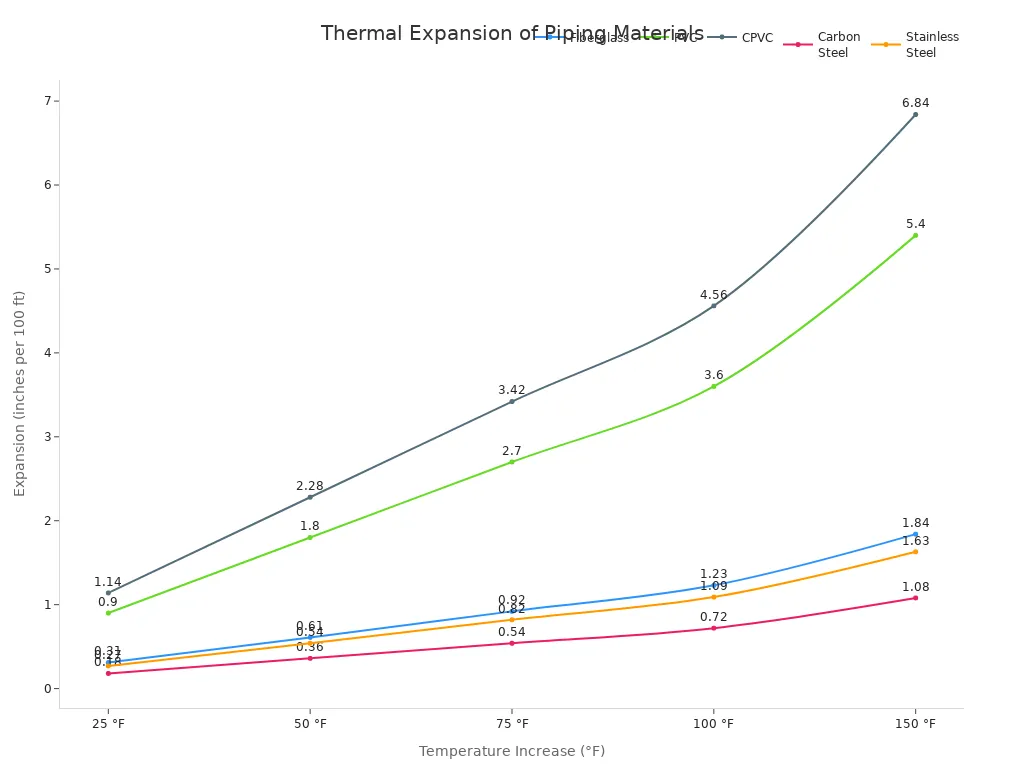
What to Look For: Failure Modes & Warning Signs
In the field, this stress shows up as specific failures. When a valve is hard to turn, leaks from the flange, or won’t control flow accurately, it’s often being stressed by the piping.
| Storingsmodus | Manifestation (What You See) | Oorzaakanalyse | Troubleshooting Method |
|---|---|---|---|
| Blockage/Stuck | Flow is blocked, valve won’t open/close, actuator is slow or stuck. | Pipe stress caused misalignment; fouling or corrosion. | Clean/derust valve; check piping alignment and supports. |
| Externe lekkage | Visible moisture/drips at flange gaskets or packing. | Pipe expansion/contraction caused bolt loosening or gasket failure. | Retorque flens bolts; replace damaged gasket; check for pipe stress. |
| Interne lekkage | Valve passes fluid even when “closed”; poor system efficiency. | Pipe stress warped the body, preventing the seal from seating properly. | This is critical. You must verify pipe supports and alignment; may require valve replacement. |
| Sensor Failure | Inaccurate temperature readings near the valve. | Leakage or damage in the temperature sensor package. | Replace sensor; ensure proper installation. |
Engineering Solutions for Thermal Expansion
You can’t stop thermal expansion, but you can—and must—manage it. The solutions fall into two categories: good design and smart maintenance.
1. The Best Fix: Good Piping Design
The #1 solution is to design the piping system correctly from the start, following standards like ASME B31.3 (Process Piping). This involves computer stress analysis to predict movement.
- Flexible Connectors & Expansion Joints: These are the most direct solution. Metal or rubber expansion joints are designed to absorb thermal growth, isolating the valve from stress, vibration, and noise.
- Proper Supports: Adding pipe supports, anchors, and guides in the right places directs pipe movement away from sensitive equipment like valves and pumps.
- Expansion Loops: Designing “U” or “L” bends (expansion loops) into long, straight pipe runs gives the pipe a place to grow without buckling.
2. Material Selection and Maintenance
Bij JH-klep, we handle systems designed for extreme temperatures. Choosing materials with low expansion coefficients (like specialized alloys for hoge temperatuur service) helps. But more importantly, a proactive maintenance plan is essential.
- Regular Inspections: Visually inspect for leaks, rust, or external damage, especially after a system shutdown or startup (when thermal cycling is most extreme).
- Functional Testing: Annually test and recalibrate control valves to ensure they open and close at the correct setpoints.
- Torque Checks: Regularly check flange bolt torque, as thermal cycles are the number one cause of “hot loosening” that leads to leaks.
Are you dealing with a high-temperature or high-pressure system causing valve failures? Contact a JH Valve engineer to discuss custom material and valve solutions designed for thermal cycling.
FAQ (Field Notes)
What’s the real risk of thermal expansion?
Unplanned downtime. A valve that seizes or a flange that leaks can shut down your entire process. In the worst-case scenario, as the oxygen fire shows, it’s a critical safety hazard that can lead to catastrophic failure.
What’s the first thing to fail on a valve from this?
The seals. Gaskets and flange seals are the first to go, leading to external leaks. Internally, the seat seal is the next to fail, as body-warping prevents it from closing 100%, causing internal leaks and process inefficiency.
Are metal or plastic valves worse for thermal expansion?
It’s a trade-off. As the table shows, plastic pipes (like PVC) expand far more than steel, putting more stress on the system. However, metal valves in high-temp service see more extreme temperatures. Both need to be in a properly designed system with expansion joints.
What’s the #1 way to prevent failure?
Good piping design. Period. A valve, no matter how well-built, cannot withstand being bent by a pipe. Proper system design with expansion joints and supports is the only real solution. Maintenance is for catching problems the design couldn’t predict.


