


Ductile Iron and cast iron both have special advantages for valves in factories. Engineers and workers pick the best material because it affects how a valve deals with pressure, force, and how long it lasts. Many businesses use both materials because they are strong and fight rust.
- Ductile Iron valves work well when there is a lot of pressure or movement because they are strong, can bend a little, and do not break easily.
- Cast iron valves are cheaper and are good for places that are not very tough.
Tests in factories show ductile iron can bend for a short time under high pressure, but cast iron keeps its shape. This means they are strong in different ways when used for real jobs.
핵심 요약
- Ductile iron is very strong and can bend without breaking. This makes it great for valves that handle high pressure. Cast iron costs less and works well in places that are not too tough. Ductile iron has a special graphite shape that makes it last longer. It also helps it stand up to hits and bumps. Cast iron needs more care because it can break easily. It can also rust faster. You should pick the right material for your job and how much money you have.
소재 개요
Ductile Iron Basics
Ductile Iron is also called nodular iron or spheroidal graphite iron. It is special because of its structure. In 1948, engineers found it by adding magnesium to melted iron. This makes round graphite nodules form inside. These nodules let the iron bend instead of break. Ductile Iron is easy to cast like gray iron. It is strong like steel. It has a high strength-to-weight ratio. It is also easy to machine. Many industries use it because it can take hits and does not change shape easily. For more on material properties, check the Ductile Iron Society.
팁: Ductile Iron valves are good when pressure changes fast or when strong forces hit the valve.
- Key features of Ductile Iron:
- Graphite nodules that are round
- High tensile strength and can bend
- Can take hits and not change shape

Cast Iron Basics
Cast iron has been used in valves for a long time. It has graphite flakes, not nodules. These flakes make it hard but also easy to break. Cast iron can hold heavy loads and high pressure. It keeps its shape even when it is hot. Its thick structure helps make machines quieter. Learn more about cast iron vs carbon steel in our detailed guide.
| Property | Ductile Iron | 주철 |
|---|---|---|
| Graphite Structure | Spherical nodules | Flakes |
| 힘 | 높은 | 보통의 |
| Flexibility | 좋은 | 낮은 |
| Brittleness | 낮은 | 높은 |
| Impact Resistance | Strong | Weak |
- Main qualities of cast iron:
- Strong and lasts long under heavy loads
- Does not burn in high heat
- Makes machines quieter
Common Industrial Uses
Many industries use both ductile iron and cast iron valves. Each material is picked for its special traits.
- High-pressure valves in water systems, chemical plants, and oil refineries
- Water and wastewater treatment plants
- Chemical places that need heat and rust resistance
- Oil and gas jobs with high pressure and rust
- Hydraulic systems that need strength and no bending
- 발전소, especially ones that burn coal
- Farm irrigation systems
Each job uses the best part of ductile iron or cast iron. Engineers choose the right one for what the job needs.
Composition and Structure
Graphite Microstructure
How graphite forms inside iron changes how it works. Ductile iron and cast iron may look alike, but their graphite shapes are not the same. Ductile iron has graphite in round, ball shapes called nodules. These nodules let the iron bend and stretch without breaking. Cast iron has graphite in thin flakes. These flakes make the iron hard but easy to crack. Spherical graphite in ductile iron spreads out stress better. This helps ductile iron handle sudden hits or pressure changes. Flake graphite in cast iron makes weak spots. Stress builds up at the ends of the flakes. This can cause cracks and breaks.
메모: The shape of graphite inside iron decides if a valve bends or breaks under pressure. Ductile iron valves last longer in tough jobs because of their nodular graphite.
Chemical Differences
The chemical makeup of ductile iron and cast iron changes how they work in valves. Both have a lot of iron and carbon. Small changes in other elements matter a lot.
| Property | Ductile Iron | 주철 |
|---|---|---|
| Iron (Fe) content | ~94% | 96-98% |
| Carbon (C) content | 3% to 5% | 3% to 5% |
| Silicon (Si) content | 2.2% – 2.8% | Lower than ductile |
| Nodulizer | Magnesium (or tellurium/cerium) | Not applicable |
| Trace elements | Varies | Varies |
Ductile iron uses magnesium or other nodulizers. These help make the round graphite nodules. Cast iron does not use these, so its graphite stays in flakes. Ductile iron has more silicon, which also helps make nodules. Even small changes in these elements can change how the iron acts in a valve.
Engineers choose the right iron by looking at these details. The structure and chemistry decide if a valve can handle stress, pressure, and long use.
Mechanical Properties
Strength and Toughness
Strength and toughness show how well a valve handles force. Ductile iron is strong like mild steel. It can hold 40,000 to 45,000 PSI before it bends. Gray cast iron does not bend. It breaks when pushed too hard. Ductile iron can stretch up to 18% before it snaps. Cast iron stretches less than 1%. Ductile iron can pull up to 120,000 PSI before breaking. This is much more than cast iron. Ductile iron valves last longer in tough places. They do not break when bent or twisted. Many companies use ductile iron for city pipes and utility poles. It does not break easily and stays safe under stress.
- Ductile iron is strong and stretches a lot.
- Cast iron cracks if you push it too hard.
- Ductile iron is better for important jobs.
Ductility and Flexibility
Ductility and flexibility show how much a valve can bend. Ductile iron has graphite nodules inside. These let it bend and flex without breaking. Cast iron has graphite flakes. This makes it easy to snap. The table below shows how they are different:
| Property | Ductile Iron | 주철 |
|---|---|---|
| Ductility | Bends a lot, does not break | Brittle, snaps when bent |
| Flexibility | Very flexible, good for hard jobs | Not flexible, not for hard jobs |
Ductile iron uses magnesium or cerium to make nodules. This gives it more toughness and lets it bend. Cast iron does not have this. It breaks more easily when stressed.
- Ductile iron bends and flexes in hard jobs.
- Cast iron is brittle and snaps under pressure.
Corrosion and Wear Resistance
Corrosion and wear resistance help valves last longer. Ductile iron fights rust better. Its nodules lower stress and stop cracks. Cast iron can rust if not protected. Ductile iron works well in hot, high-pressure, and rusty places. It is used in oil and chemical plants. Cast iron does not fight acid well and breaks easily. This makes it bad for tough jobs. For extreme corrosion, check our intergranular corrosion guide.
- Ductile iron is best for rough and changing places.
- Cast iron needs a coating to stop rust.
- Ductile iron lasts longer where there is a lot of impact and rust.
Ductile Iron Performance
압력 및 온도 등급
Engineers need to know how valves handle pressure and heat. Ductile iron valves are used in water and factory systems. They can take high pressure, but this changes with heat. As the temperature goes up, they get weaker. Learn more about how temperature affects valve pressure ratings in our guide. The table below shows how ductile iron and cast iron do at different heats:
| Temperature (°F/°C) | Cast Iron (ASTM A 126) | Ductile Iron (ASTM A 395) |
|---|---|---|
| -20°F to 100°F | 200 psi | 150 psi |
| 150°F (66°C) | 200 psi | 150 psi |
| 200°F (93°C) | 190 psi | 135 psi |
| 250°F (121°C) | 175 psi | 125 psi |
| 300°F (149°C) | 165 psi | 110 psi |
| 350°F (177°C) | 150 psi | 100 psi |
| 400°F (204°C) | 140 psi | 해당 없음 |
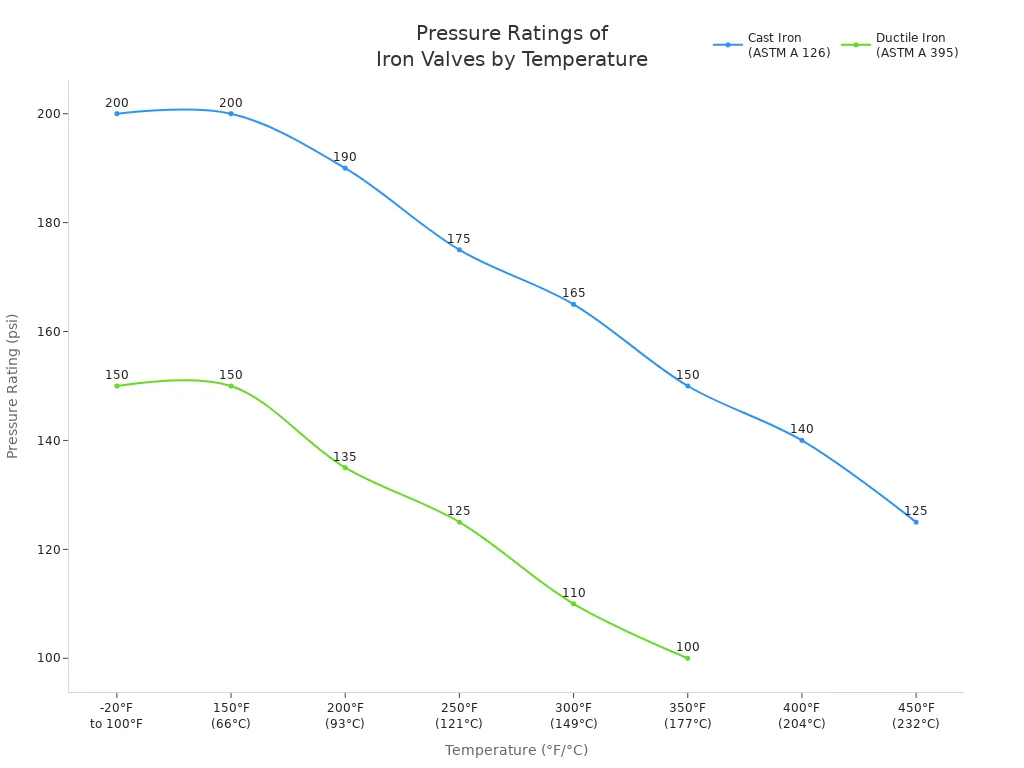
Both ductile iron and cast iron lose strength as heat rises. Cast iron can take more pressure when it is very hot. Ductile iron is better for cooler or warm jobs. Many water plants use ductile iron because it stays strong most of the time. For critical standards, see ASTM A395.
Note: Always look at pressure and heat ratings before picking a valve.
Impact and Crack Resistance
Ductile iron is tough and does not break easily. It can take a hit or drop without cracking. This makes it good for places with sudden bumps or shaking.
- Ductile iron lasts longer than cast iron.
- It bends instead of breaking, so it does not crack.
- Cast iron is harder but can break if hit.
Workers use ductile iron valves in busy places. These valves do not crack or break from hits. This keeps water and factory systems safe and working well.
Durability and Service Life
Longevity in Valve Use
Engineers want to know how long a valve will last. Ductile iron valves are very tough in factories. Many water plants use ductile iron because it lasts a long time. Cast iron valves also work for many years, but not as long. The table below shows how long each one lasts:
| 재료 | Average Service Life |
|---|---|
| Ductile Iron | At least 100 years |
| 주철 | 50 to 100 years |
Ductile iron valves can last 100 years or more. Their cement lining helps stop rust, so they stay strong. Cast iron valves can last up to 100 years, but need more care. Rust and breaking can make them wear out sooner. Workers have to check cast iron valves more often to keep them safe.
팁: Ductile iron valves do not need much fixing because they fight rust and cracks.
Failure Resistance
If a valve fails, it can leak or break things. Ductile iron valves are good because they do not crack or bend easily. Their flexible shape lets them handle high pressure and heat changes. Cast iron valves are strong but stiff. They can crack or bend if pushed too hard. Check our common valve failures guide for more info.
- Ductile iron valves cost more at first, but save money later. They are strong and bendy, so they need fewer repairs.
- Cast iron valves are cheaper to buy, but break more often. This means more fixing and higher costs later.
- Ductile iron does not crack when bent, so it is good for hard jobs.
- Cast iron can break if bent or hit suddenly.
Ductile iron valves have cement lining to stop rust. This helps them last longer and need less fixing. Cast iron valves need more care because they rust and crack more. Workers must check and fix cast iron valves more to keep things safe.
Ductile iron valves are more reliable and last longer, so they are a smart pick for tough factory jobs.
Cost and Installation
Material and Manufacturing Costs
Ductile iron and cast iron both help save money, but their prices are not the same. Cast iron is usually cheaper to make. The materials cost less, and making it is easy. Many factories pick cast iron valves when they do not have much money to spend. Ductile iron costs more because it needs extra steps. Workers add magnesium or other things to make the nodular structure. This makes ductile iron stronger and able to bend, but it also makes it cost more. Visit our valve manufacturing process page to see how we make them.
| 재료 | Average Cost per Pound | Manufacturing Complexity | Typical Use Case |
|---|---|---|---|
| 주철 | 낮은 | Simple | Low-pressure systems |
| Ductile Iron | 보통의 | More steps | High-pressure systems |
💡 팁: Ductile iron might cost more at first, but it can save money later. It lasts longer and does not need as many repairs.
Installation and Handling
Workers say ductile iron valves are easier to put in than cast iron valves. Ductile iron valves use push-fit joints. These joints let workers connect pipes fast and change lines easily. Cast iron valves need stiff joints or flanged connections. These are harder to line up and take more time to install.
- Ductile iron valves make it easy to change and connect pipes.
- Cast iron valves need careful lining up and take longer to put in.
- It is easier to take care of ductile iron valves. Workers can check and fix them without taking everything apart.
- Cast iron valves are heavier and harder to move. Fixing them takes more work and more time.
Workers pick ductile iron valves when they want fast work and easy fixing. Cast iron valves are better when saving money is most important and the system does not change much.
Valve Applications Comparison
Suitability for High-Demand Uses
Engineers pick valve materials by how well they do hard jobs. Some factories need valves that work with high pressure or heat, or where there is a lot of rust. Ductile iron and cast iron are both strong, but they act differently in these places.
The table below shows why many companies use ductile iron for tough jobs:
| Property | Importance in Industrial Applications |
|---|---|
| 힘 | Ductile iron is strong and works well under high pressure. |
| 내구성 | It lasts longer in rough places, so workers do not change valves as much. |
| Machinability | Factories can make special valve shapes to help them work better. |
| 내식성 | Ductile iron does not rust easily, which is good for oil and gas plants. |
| Cost-Effectiveness | It works well and does not cost too much, so factories like it. |
| Versatility | Ductile iron can be used for many types of valves in different jobs. |
Ductile iron valves work better than cast iron in hard places. They bend instead of breaking, so they last longer and need less fixing.
In real life, ductile iron valves are strong and last a long time. They do not crack when bent and do not rust as fast as cast iron. Cast iron valves can take high pressure, but they break more easily. If you bend or hit them, they might crack. Cast iron also needs more fixing because it rusts faster.
- Grey cast iron is strong and can take high pressure, but it will crack if bent. It needs regular checks for rust.
- Ductile iron is strong, takes high pressure and heat, and does not crack as much. It rusts less than grey cast iron.
Ductile iron valves are best for water plants, oil refineries, and chemical factories. These places need valves that can handle quick changes in pressure and heat. Cast iron valves are better for places where saving money is important and the pressure is not very high.
Typical Valve Types
Different valves use ductile iron or cast iron depending on the job. The table below shows which material is best for each valve:
| 밸브 유형 | 재질 유형 | 장점 | 응용 프로그램 |
|---|---|---|---|
| 게이트 밸브 | Ductile Iron | Strong, lasts long, bends without breaking, does not rust easily | High-pressure jobs |
| 주철 | Costs less, good for high heat, strong when squeezed | Jobs where saving money is important |
Ductile iron 게이트 밸브 are good for high-pressure water systems and oil plants. They last longer and do not need as many repairs. Cast iron gate valves cost less and work well with heat. They are best for low-pressure jobs or when money is tight.

- Ductile iron valves: Very strong and last long, good for high pressure and places with lots of rust.
- Cast iron valves: Cost less, best for jobs with lower pressure.
Tip: Always pick the right valve material for the job. Use ductile iron for hard, high-pressure work. Use cast iron when saving money is most important and the job is not too hard.
Material Selection Guide
Key Factors to Consider
Engineers think about many things before picking a valve material. Each thing helps them know if the valve will work well and last long. Here are the main things to look at: * What kind of stress the valve will face and what it needs to do * How strong and tough the valve is * If the valve is a good deal for the money * How much weight the valve must hold up * How much force the valve can take * If the valve keeps its shape over time * Where the valve will be used, like wet, hot, or dirty places * How simple it is to make the valve * How much money is set aside for the project
Fatigue strength tells us if a valve can handle lots of pressure or shaking again and again without breaking. This is important for valves that work all the time.
The table below shows how ductile iron and cast iron are different in important ways:
| Property | Ductile Iron | 주철 |
|---|---|---|
| Tensile Strength | Superior tensile strength | Strong but lacks ductility |
| Resistance to Bending | High resistance to bending and cracking | Prone to cracking under stress |
| 비용 | Higher due to complex manufacturing | More economical due to simpler process |
| 온도 내성 | Suitable for high-temperature applications | Limited temperature tolerance |
| 압력 등급 | Capable of handling high pressures | Strong but may crack under excessive force |
| 내식성 | More corrosion-resistant | Prone to rust over time |
Ductile iron has a special graphite shape inside. This helps it fight rust. That makes it a smart pick for 밸브 that touch water or strong chemicals.
Ductile iron and cast iron are both good for valves, but in different ways. Ductile iron is stronger, bends more, and does not break or rust as easily. Cast iron costs less and works well for easier jobs. When picking a valve material, engineers should think about a few things:
- If the material works with the fluid and where it will be used
- How well it fights rust and heat
- If it is good for wet places so it does not leak or break
These points help engineers pick the right material. This way, valves work well and last a long time.
자주 묻는 질문
What makes ductile iron better for high-pressure valves?
Ductile iron has round graphite nodules. These nodules let the iron bend and stretch. This helps valves handle high pressure without cracking. Many engineers pick ductile iron for tough jobs because it stays strong and safe.
Can cast iron valves be used for drinking water systems?
Yes, cast iron valves can be used for drinking water. They need a safe lining to stop rust and keep water clean. Many water plants use cast iron, but ductile iron lasts longer and needs less care.
How do you tell ductile iron from cast iron?
Look at the inside structure. Ductile iron has round nodules. Cast iron has thin flakes. Sometimes, a magnet test or a small cut can show the difference. Labels or markings on the valve also help.
Are ductile iron valves more expensive to install?
Ductile iron valves cost more to buy. They are easier to install because they use push-fit joints. Workers spend less time and effort putting them in. Over time, ductile iron saves money on repairs.
Which material lasts longer in outdoor conditions?
Ductile iron lasts longer outside. It fights rust better and does not crack from cold or heat. Cast iron can rust and break faster if left in the weather. Ductile iron valves work well in outdoor jobs.

